If you are a pathologist, you know the path a narrative report on an oncology specimen takes. The oncologist hunts for margin status in the third paragraph. The surgeon calls to ask how many lymph nodes were examined. Months later, someone reporting to the Cuenta de Alto Costo (CAC, Colombia's high-cost disease registry) tries to infer the grade from text that only mentioned it implicitly.
The synoptic report exists so that does not happen. It does not replace the pathologist's judgment or the description: it adds a structure in which every data point that matters has a fixed place and cannot be left out without anyone noticing.
In short
- A synoptic report presents tumor data as field and value pairs, with a defined list of elements for each cancer type.
- The ICCR divides its elements into core, essential for management, staging or prognosis, and non-core, recommended. Together, the core elements make up the minimum reporting standard.
- Histeva ships with 22 report templates, 9 of them oncology protocols based on ICCR, and codes in ICD-10, ICD-O-3.2 and SNOMED CT.
- Histeva does not allow sign-out of an oncology report with empty required synoptic fields or missing codes.
- The coded report prefills the cancer report to the CAC (Resolution 247 of 2014) and events 155 and 115 in SIVIGILA, Colombia's public health surveillance system.
- AI proposes the synoptic draft and checks consistency before sign-out, but does not sign or change the case status.
Free text versus synoptic report
A free-text report depends on the memory and style of whoever writes it. Two pathologists in the same lab can report the same specimen with different structures, and both can be correct. The problem shows up when someone else has to find a data point: the clinician, the tumor board, the EPS (health insurer) auditor or the cancer registry.
The synoptic report solves two things at once. For the reader, every data point is always in the same place. For the lab, completeness no longer depends on memory: if the protocol requires margin status, the field is there, empty, until someone fills it in.
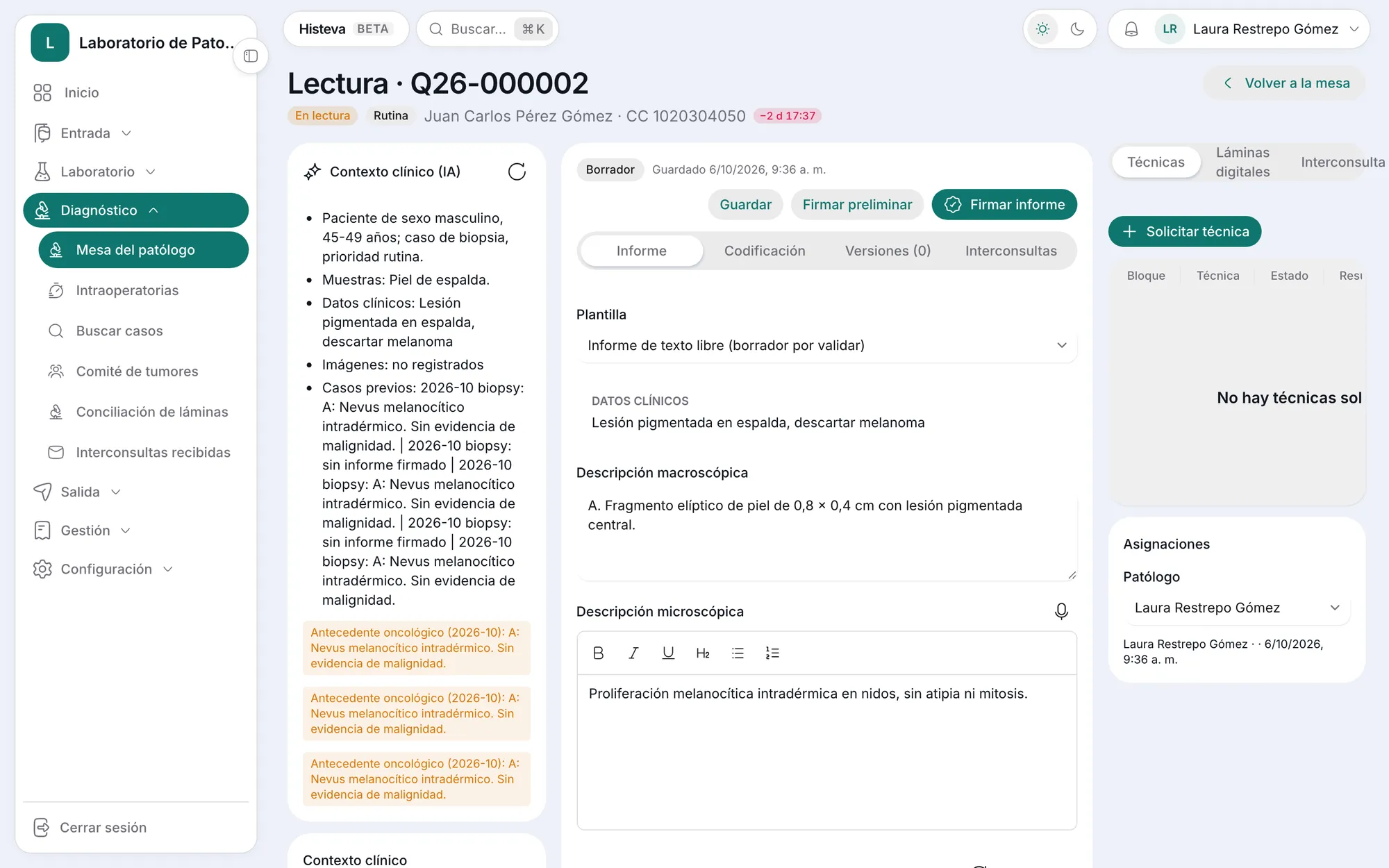
Going synoptic does not eliminate prose. In Histeva, the report keeps the gross description, the microscopic description, one diagnosis line per specimen, the stains and techniques results table and a free-text comment. The synoptic data is added on top of that.
What ICCR protocols are
The ICCR (International Collaboration on Cancer Reporting) publishes evidence-based reporting datasets for different cancer types, with a common style and content. Their practical value lies in one distinction:
- Core elements. They are essential for clinical management, staging or prognosis, and are backed by evidence. All the core elements for a given cancer together make up the minimum reporting standard.
- Non-core elements. They were agreed on as part of the dataset and are recommended as good practice, but do not have the same level of evidence.
That distinction helps decide what should block sign-out and what should not. An empty core field means an incomplete report. An empty non-core field can be a reasonable decision.
Histeva's oncology protocols
Histeva's oncology templates are based on ICCR datasets, written in Spanish, and each one defines its own required fields.
| Template | Some required fields |
|---|---|
| Invasive breast carcinoma (resection) | Nottingham grade, margins, nodes examined and involved, ER, PR, HER2, pT and pN |
| Breast carcinoma on core needle biopsy | Number of cores, histologic type and grade, ER, PR and HER2 |
| Colorectal carcinoma (resection) | Extramural venous invasion, tumor budding, margins, mismatch repair proteins, pT and pN |
| Prostate adenocarcinoma (needle biopsy) | Total cores and cores with carcinoma |
| Cervical carcinoma | Procedure, histologic type and lymphovascular space invasion |
| Endometrial carcinoma (hysterectomy) | Myometrial invasion, molecular subtype and FIGO 2023 stage |
| Primary cutaneous melanoma | Subtype, peripheral margin, deep margin and pT |
| Lung carcinoma (resection) | Visceral pleural invasion, margins, pT and pN |
| Thyroid carcinoma | Capsular and vascular invasion, extrathyroidal extension, pT and pN |
Many fields become required depending on the answer to another field. In breast, if the patient received neoadjuvant therapy, treatment response becomes required. If the margins are clear, the distance to the closest margin is required. If there are involved nodes, extranodal extension is required. In prostate, when there are cores with carcinoma, the Gleason pattern and the ISUP grade group are required.
The other 13 templates cover non-oncologic diagnoses by organ, such as gastrointestinal biopsy, inflammatory skin disease or placenta, cytology (Bethesda 2014, the Paris System, thyroid Bethesda and serous fluids) and a free-text report.
Coding: ICD-10, ICD-O-3.2 and SNOMED CT
A synoptic report without codes is still hard to query. Histeva codes every report in three systems:
- ICD-10, the diagnosis classification used by the health system and for billing.
- ICD-O-3.2, the oncology classification, with topography (where the tumor is) and morphology with its behavior code, which distinguishes benign, in situ and malignant, among others.
- SNOMED CT, which is loaded when the lab holds the corresponding license.
Each template suggests the expected codes for its organ, and the coding agent proposes codes limited to the loaded catalog. Searching previous cases works by diagnosis text and by code, so you can find every case with a given morphology regardless of how it was worded.
Why completeness matters for the CAC
Reporting cancer patients to the Cuenta de Alto Costo, governed by Resolution 247 of 2014, involves data that originates in the pathology report. If the report does not state that data explicitly, someone reconstructs it by hand later, or it gets reported incomplete.
In Histeva, when an oncology case is signed out, a draft CAC record is created, prefilled from the coded report and the stains and techniques results: the date and histopathologic confirmation of the diagnosis, topography and morphology in ICD-O-3.2, the ICD-10 code, grade, laterality and, for breast, hormone receptors, HER2 and Ki-67. A lab auditor reviews and validates that draft before exporting it. Clinical staging fields are left for whoever has that information. The same applies to SIVIGILA events 155 and 115. This is where the value of a complete report shows: what the pathologist signed reaches the registry without being retyped.
Sign-out, versions and hard stops
Before sign-out, Histeva checks that each specimen has its diagnosis line, that the required synoptic fields are filled in and that the oncology case has codes. If there are pending stains or techniques, it warns you and requires a reason to sign out anyway.
Sign-out uses TOTP two-factor authentication. Each version is stored as an immutable document with a SHA-256 hash and published as a PDF/A with a QR code that anyone can scan to verify its validity. Correcting a signed report does not overwrite it: you issue an addendum or an amendment with a reason, and the previous version stays intact. The slides that support the diagnosis are tracked in their chain of custody. See pathology specimen tracking.
What AI does, and what it does not
Two agents support the report. The synoptic draft agent takes your dictation or microscopic text and proposes values for the template fields, which you choose to apply. Before sign-out, the consistency agent checks laterality, organ, sex and age against the diagnosis, missing fields and the coherence of the immunohistochemistry, and shows what it finds in the sign-out dialog.
Neither one signs, neither one changes the case status, and neither one receives the patient's name or ID number. All agents start switched off and are only enabled after an approved evaluation.
To see the report within the full workflow, check out pathology software, reading with digital pathology, how signed-out cases become charges in pathology lab billing, or book a demo.