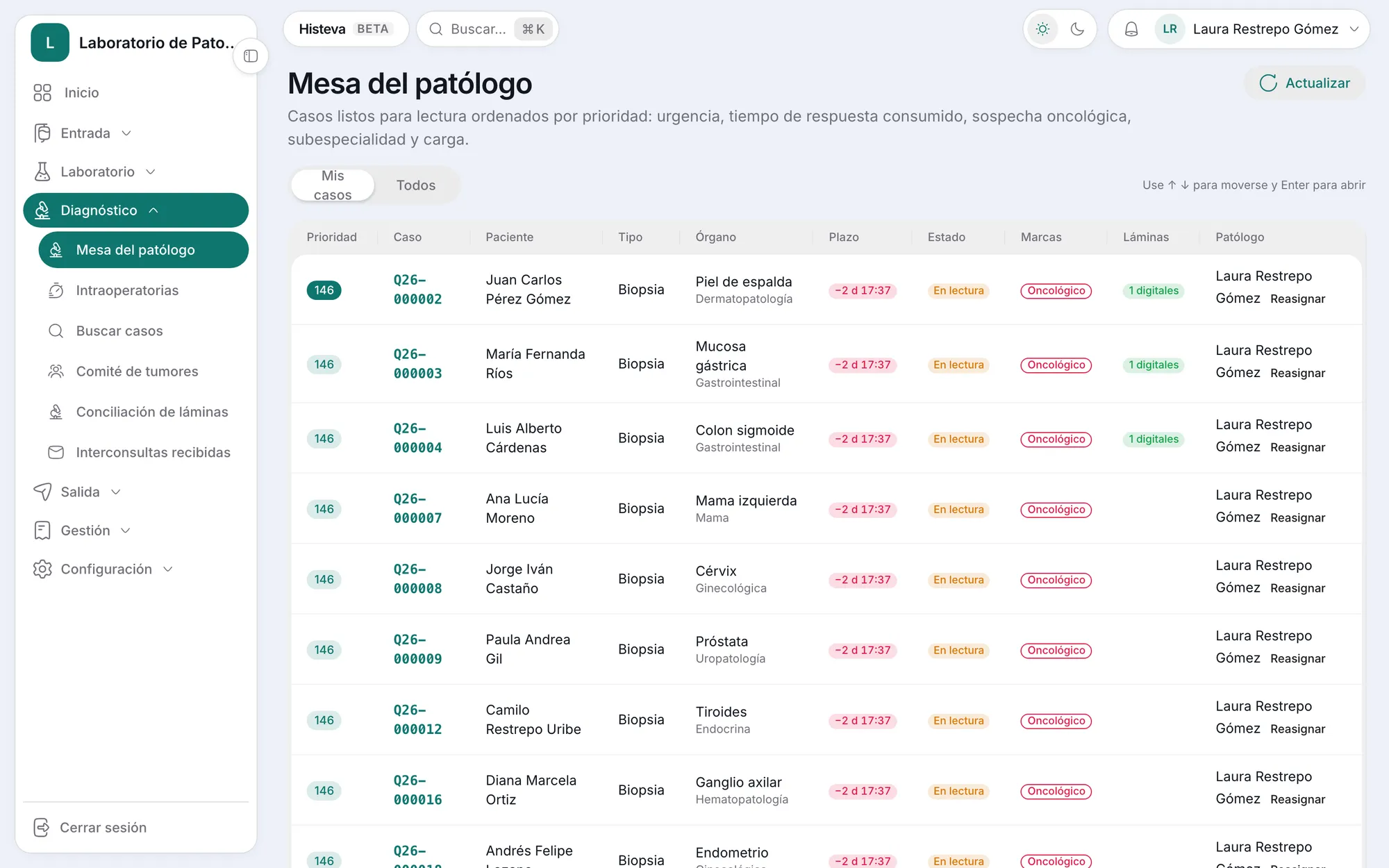
If you run a pathology lab, you know that a case with three specimen containers can end up as dozens of cassettes and slides, spread across the tissue processor, the microtome, staining, the pathologist's desk and, with luck, the archive. When someone asks where slide A3-2 is, the answer shouldn't depend on who was on shift.
This guide explains how to build a chain of custody in pathology, object by object, from the moment the specimen leaves the procedure room until it is discarded years later, and what to measure to know whether it works.
In short
- Pathology traceability follows every physical object: specimen container, cassette, slide and image, not just the case.
- Every object carries a DataMatrix code with human-readable text and two patient identifiers.
- Every scan at a station is stored as an append-only event, with object, station, action, user, device and time.
- Histeva warns you when an object reaches a station out of order, and rejects the scan at a station where that object doesn't belong.
- If the internet goes down, the site's Edge keeps accessioning specimens with reserved numbers and syncs when the connection returns.
- Blocks and slides are retained for 15 years by default in Histeva, and disposal only goes ahead with approval.
Before the lab: the upstream chain
Custody doesn't start at accessioning. It starts when the specimen is collected and someone hands it to a courier.
In Histeva, collection routes are defined by days and stops, and the courier works from a phone: they scan the specimen containers at each facility, record the fixation start time and a temperature note, and collect the signature of the person handing them over. Each stop generates a PDF manifest. If a container that was picked up doesn't reach the lab within the configured time window, an alert is raised.
For breast specimens, the order requires the collection time and the fixation start time. These are the data points that document cold ischemia time and time in formalin, which affect hormone receptors and HER2, and they are much harder to reconstruct after the fact.
Accessioning: two identifiers and container reconciliation
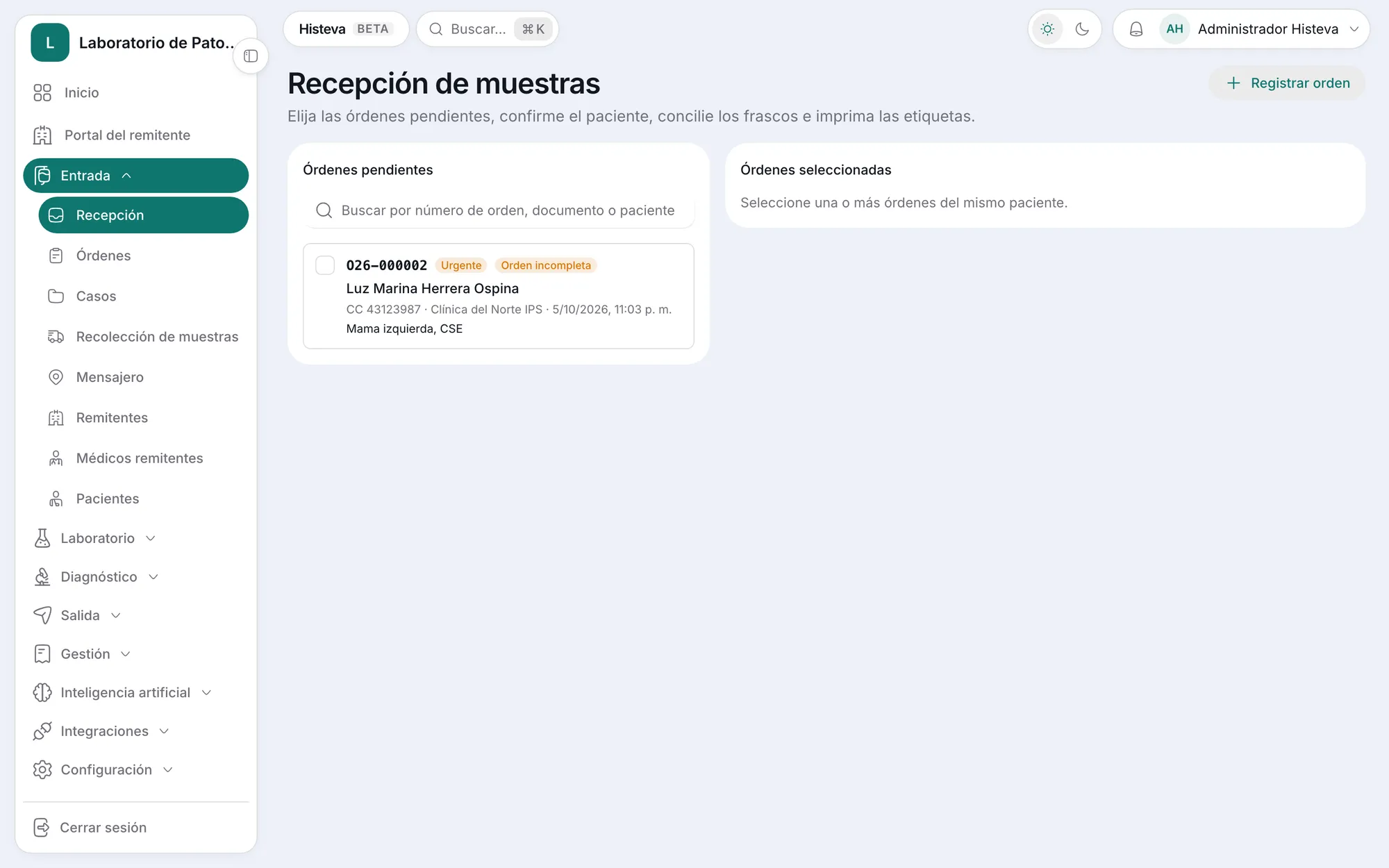
Accessioning is the first point where an error can be stopped, and the last point where stopping it is cheap. In Histeva, the workflow targets under 2 minutes per case:
- You select the patient's pending orders, and there may be several.
- You confirm the patient with two identifiers.
- You register the specimen containers by scanning them, and Histeva reconciles them against the ones declared in the order.
- You record discrepancies: a name that doesn't match, a different number of containers, a different site or laterality, or a container that is unlabeled, spilled or without fixative.
- The case is created and the DataMatrix labels are printed, with a target of under 3 seconds per label.
If the order arrived incomplete, the screen shows what's missing and the case is flagged, without holding up the specimen's intake. If the specimen has to be rejected, the reason comes from a catalog, which later lets you measure why specimens get rejected and which referring clients send the most problems.
One code for every object
The hierarchy is the foundation for everything else. Each code contains the one before it, so just by reading a slide you know which cassette, container and case it comes from.
| Object | Example code | Where it is created |
|---|---|---|
| Case | Q26-000123 | Accessioning, with a prefix by case type and year |
| Specimen container or part | Q26-000123-A | Accessioning |
| Cassette or block | Q26-000123-A1 | Grossing |
| Slide | Q26-000123-A1-1 | Sectioning |
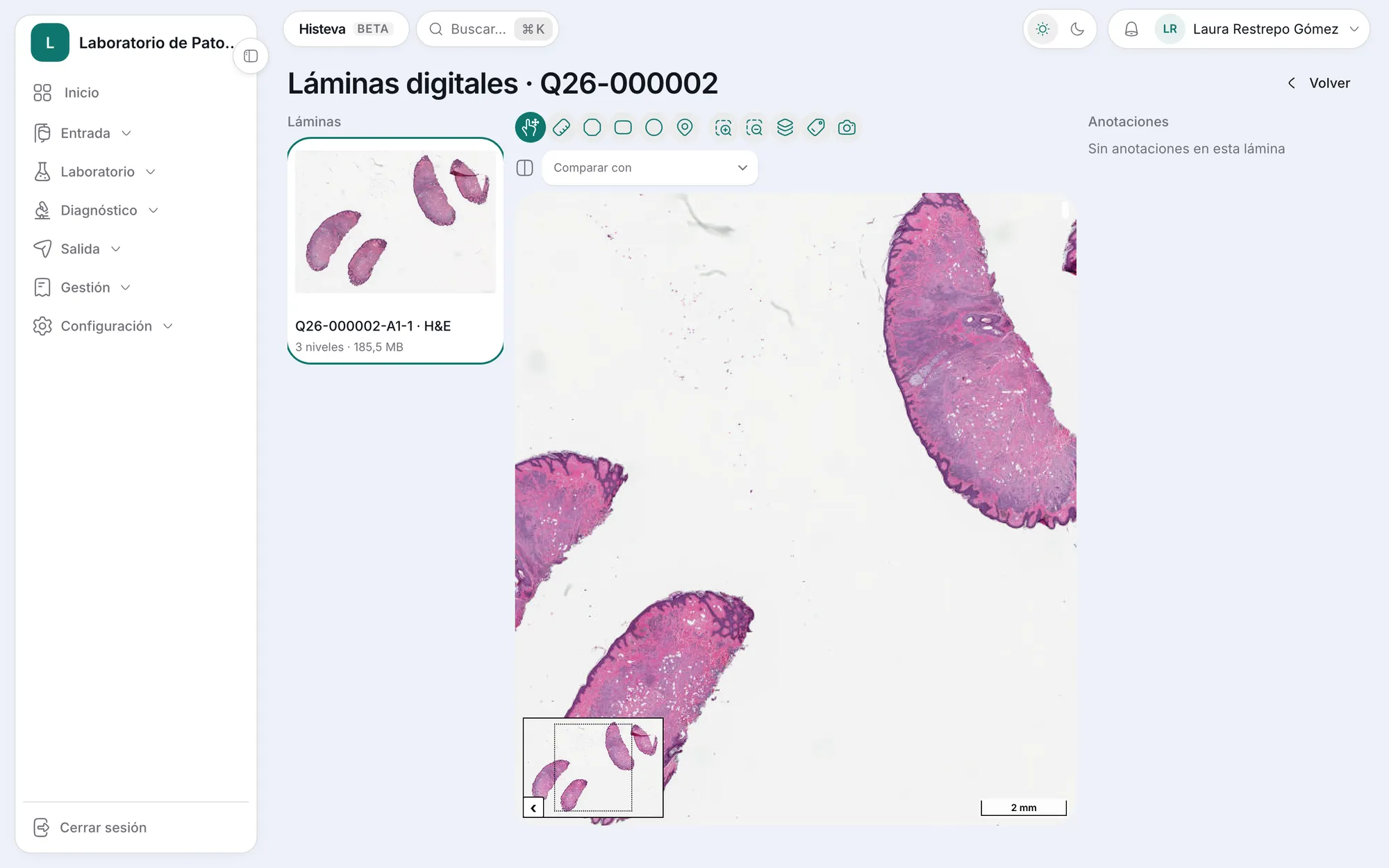
| Digital image | Takes the code of its slide | Scanning |
The labels are DataMatrix ECC 200, a two-dimensional code that fits on the edge of a cassette or a slide, with human-readable text beside it. The site's Edge prints them on ZPL printers, and if a site has no printer, the label comes out as a PDF. The same code that identifies the slide in the lab is the one that links it to its image. See digital pathology.
Scan-based stations
Every station in the lab works by scanning: processing, embedding, sectioning, staining, coverslipping and delivery to the pathologist. Scanning an object records that station's action. Nobody has to type anything in at the end of the day, and if a cassette skips a station, the next scan makes it obvious.
When you scan, the station shows the object and its case. If the object arrives out of the expected order, Histeva warns you, showing its last movement and the step that was expected. If that type of object doesn't belong at the station, for example a slide at embedding, the scan is rejected. At sectioning, scanning a block lets you create its slides, whether H&E, levels or any pending stains and techniques, and print their labels in the same step.
A real-time board shows cases grouped by their next step, with work-in-progress limits per station, so you can see where work is piling up.
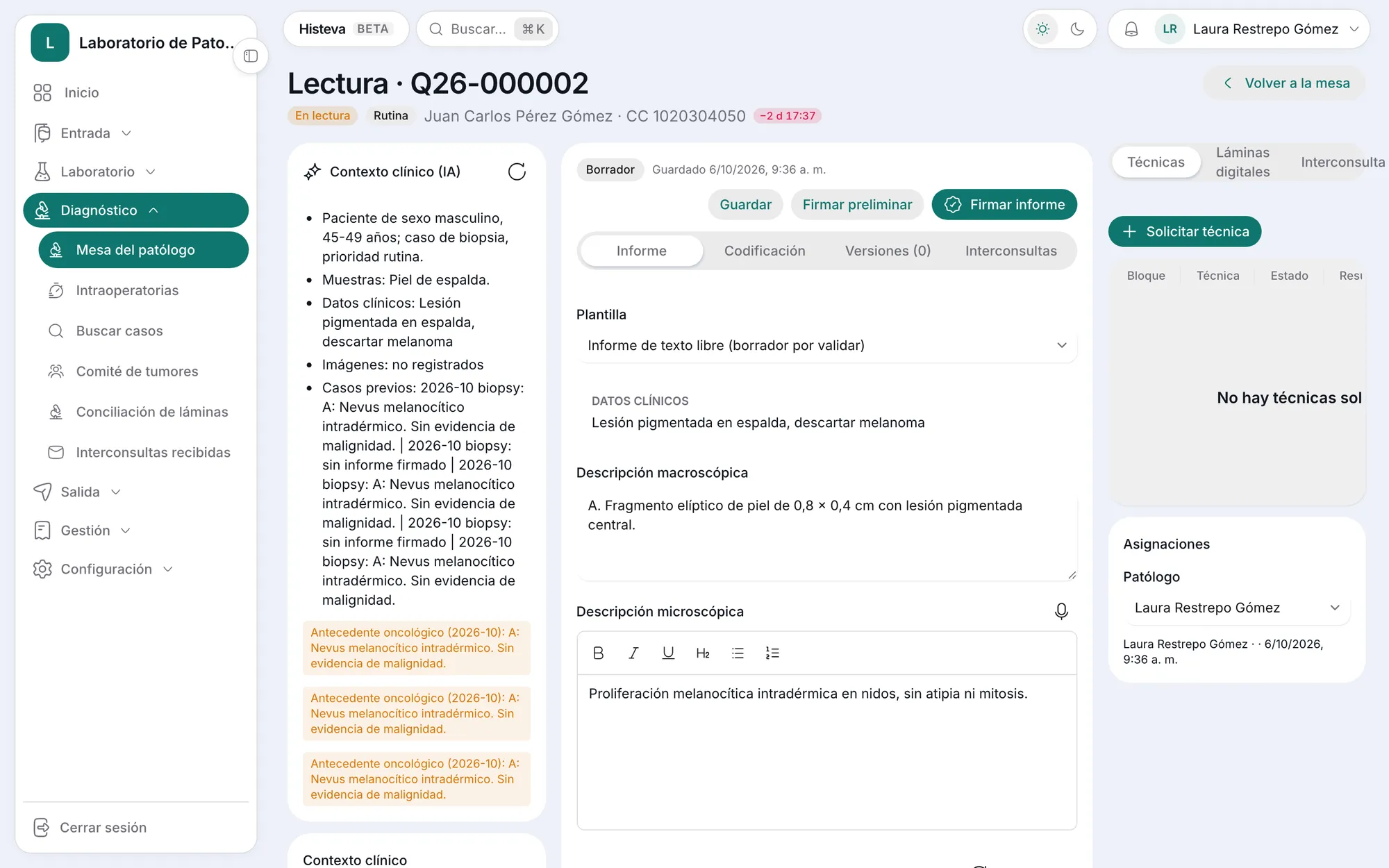
Additional stains and techniques, such as immunohistochemistry, are orders placed on a block that produce new slides and come back to the same case. The case only moves on to reading when all of its slides have been delivered and no stain or technique is still pending.
When the specimen leaves the lab
There are three common ways out, and all three have to stay in the chain:
- Send-outs to external labs, for example for molecular testing: every block or slide sent is recorded as it goes out and again when it comes back, with an alert if the expected time window runs out.
- Physical consultations, with the courier's waybill and custody recorded on the way out and on the way back.
- Loans to patients, institutions or physicians, with a purpose and a return date, which are flagged as overdue if they aren't returned on time. Loans for research require consent.
Archive: 15 years and disposal with approval
The archive is organized by site, room, cabinet, drawer and position. Archiving is another scan-based station, and you can archive an entire case in a single step.
By default, Histeva comes with a 15-year retention period for blocks and slides, and a configurable number of days for residual tissue in formalin. Each month it proposes what has reached the end of its retention period, but it never deletes anything on its own: disposal only runs with approval and is recorded in the chain of custody. Set the period with your legal and quality teams, because Histeva enforces it but doesn't decide it for you.
The "Where is it?" search answers by code or by case with the location, loan or disposal of each object.
Offline, custody carries on
If a site loses its internet connection, the local Edge keeps working: it accessions specimens using a range of case numbers reserved in advance for that site, records custody scans and prints labels. When the connection comes back, everything syncs with no duplicates. Signing reports does require a connection. See pathology software.
What to measure
A chain of custody that isn't measured degrades quietly. These indicators come from the same events, with no extra work:
- Rejections by reason and by referring client.
- Time per stage and by case type, in business days.
- Output per station and per histotechnologist, in blocks and slides.
- Slide quality failures, such as folds, knife marks or staining problems, which are recorded as nonconformities.
Stage times also support the report: a case that is signed out on time is one that didn't get stuck at a station. See synoptic pathology report. And every tracked slide and technique is also a billable activity, as the pathology lab billing guide explains.
You can explore the features or book a demo.