If you run billing for a pathology lab, you already know a case is not billed at a single moment. The immunohistochemistry was completed on Monday, the biopsy was signed out on Tuesday, the consultation came back the following week, and recuts may not be billable at all, depending on the payer contract. When all of that is pieced together at month end from spreadsheets, something goes unbilled or gets billed twice, and the EPS (Colombia's health insurers) finds it before you do.
This guide explains how a pathology lab's activity turns into invoices, RIPS and accounts receivable under the rules that apply in Colombia today, and how Histeva handles it.
In short
- In Histeva, charges are not keyed in by hand: signing out the case, every completed stain or technique, every intraoperative consultation and every consultation generate billable items according to the payer contract.
- Electronic invoices are issued to the DIAN (Colombia's tax authority) under Resolution 000165 of 2023, amended by Resolution 000008 of 2024.
- When the payer is an entity responsible for payment, the invoice carries RIPS (Colombia's individual health service records) as supporting documentation under Resolution 948 of 2026, and without a CUV (the RIPS validation code) the claim cannot be submitted.
- Supporting documents are submitted within 22 business days of the invoice being issued (Resolution 2284 of 2023).
- Payer objections (glosas) can only rest on a closed list of grounds (Resolution 2284 of 2023) and follow chained deadlines (Law 1438 of 2011, Article 57).
- If the institution already bills in Omneri HIS, Histeva delivers ready-to-bill items and does not issue invoices.
Why pathology billing is different
Activity is spread out over time. A single case produces charges at different moments: the base study at sign-out, each stain or technique when it is completed, the intraoperative consultation when the result is communicated, and the consultation when the response arrives. If billing waits for the case to close to remember everything that came before, it depends on memory.
Quantities depend on the specimens. Two biopsy containers are not one biopsy, and an oncologic surgical specimen with margins is not billed the same as a gross-only specimen.
Stains and techniques are counted per unit. A breast panel with estrogen receptor, progesterone receptor, HER2 and Ki-67 is four immunohistochemistry stains, not one.
Payers vary. A lab may bill an EPS, the IPS (healthcare provider) that refers its specimens, an ARL (occupational risk insurer), a SOAT insurer (mandatory traffic accident insurance), a prepaid health plan or a self-pay patient, and each one has its own payer contract, rate and supporting documents.
What gets billed depends on the payer contract. Recuts, levels or review of outside material are billable under some contracts and not under others.
From activity to billable item
In Histeva, every billable item originates from a case event. A rule defines which event generates it, which case type or stain it applies to, which CUPS code (Colombia's procedure code list) it is billed under and how the quantity is calculated. Histeva ships with starter rules that your lab adjusts to its payer contracts:
| Activity | Event that triggers the charge | Quantity |
|---|---|---|
| Biopsy | Case sign-out | One per specimen |
| Oncologic surgical specimen with margins | Case sign-out | One per specimen |
| Cervicovaginal cytology | Case sign-out | One per case |
| Non-gynecologic cytology and FNA | Case sign-out | One per specimen |
| Review of outside material | Case sign-out | One per case |
| Immunohistochemistry | Stain or technique completed | One per antibody |
| Special stain | Stain or technique completed | One per stain |
| Intraoperative consultation | Result communicated | One per study |
| Consultation | Consultant's signed response | One per consultation |
| Recuts and levels | Stain or technique completed | Rule disabled until the lab defines it |
Three details change what you actually collect. First, if an event is processed twice, the charge is not duplicated: each item stays tied to the event that originated it. Second, if the payer contract requires prior authorization and it is missing, the item is blocked with the reason, instead of going out on an invoice that will draw a payer objection. Third, the billing analyst sees pending and blocked items by payer, fixes the authorization and approves them.
The stain or technique that generates the charge is the same one traced in the lab, with its block, its slides and its reagent lots. See pathology specimen tracking.
Payer contracts, rates and prior authorizations
Each payer has its type, NIT (tax ID), code, regime, electronic invoicing details and payment term. Each payer contract defines the payment model (fee-for-service, bundle or capitation), the base rate schedule (SOAT, ISS 2001 or a custom schedule) with its adjustment percentage, whether prior authorization is required and within how many days payer objections must be answered. Amounts come from the payer contract's rate schedule when the item is generated, not from a parallel price list.
Electronic invoicing with the DIAN
Invoices are issued to the DIAN under Resolution 000165 of 2023, amended by Resolution 000008 of 2024. Histeva groups ready items by payer, payer contract and month, or by case when the patient is self-pay, uses your lab's invoice numbering resolutions and transmits through APIDIAN. The CUFE (the invoice's unique electronic code) is stored with the invoice. Credit and debit notes, payments and the PDF and XML files all stay on the same account.
RIPS with CUV
The current rule for RIPS as supporting documentation for the electronic health invoice is Resolution 948 of 2026, issued on May 14, 2026, which repealed Resolutions 2275 of 2023, 558 of 2024 and 1884 of 2024. The underlying rule did not change: without a CUV, the invoice cannot be submitted to the payer.
Histeva builds the RIPS in JSON per invoice, from the same billable items: procedures with their CUPS code, dates, prior authorization, diagnosis, the professional's ID document and amounts. Before sending it, Histeva validates its structure and checks that the totals match the invoice, and it stores the CUV when the payer requires it.
Because a pathology lab bills very different payers, the RIPS mode is set per payer: invoice with RIPS and CUV, invoice with a supporting RIPS file, or invoice without RIPS. Which one applies to each relationship is best decided with your billing team before loading the payer contracts.
Claim submission, payer objections and accounts receivable
Every submission to a payer is recorded as a claim submission. The deadline that sinks the most accounts is the first one: submitting the supporting documents within 22 business days after the invoice is issued, under Resolution 2284 of 2023. That is why it matters that the item is created when the case is signed out and not at month end.
Payer objections are recorded per invoice item, with their grounds, amount and date received. The deadlines in Article 57 of Law 1438 of 2011 are chained: 20 business days for the payer to raise the objection, 15 to respond to it, 7 more to correct it and 10 for the payer to decide whether to lift it. Histeva alerts you before the response deadline agreed in the payer contract runs out, lets you accept, partially accept or reject, and generates the credit note for the accepted amount.
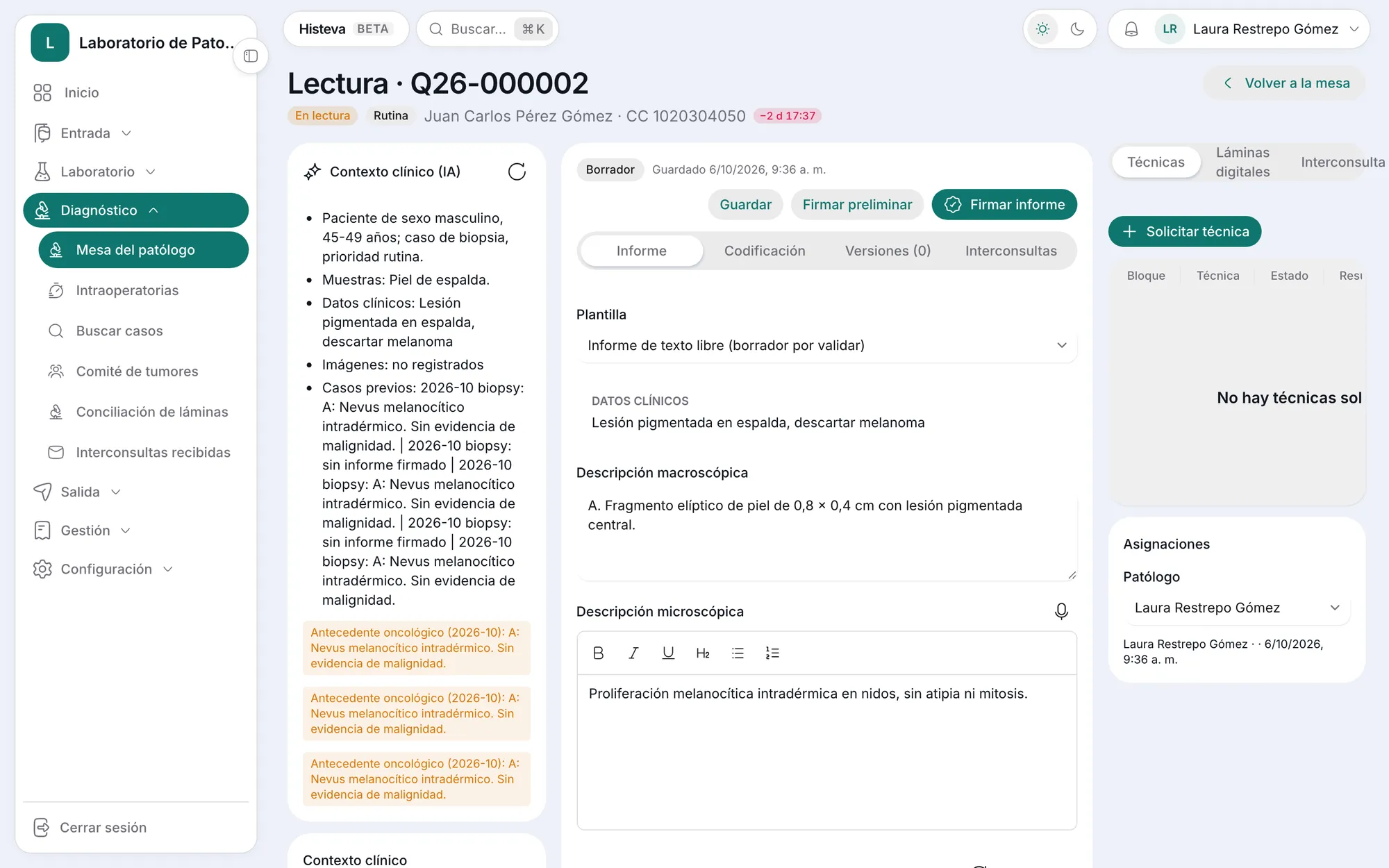
When facing a payer objection, the signed report is the clinical support for the charge. Every report signed out in Histeva is a PDF/A with a SHA-256 hash and a QR code that the payer's auditor can verify. See synoptic pathology report.
Accounts receivable can be viewed by payer and by aging, with payments applied, and everything exports to Excel.
What each case costs you
Billing correctly does not tell you whether a payer contract is profitable. In Histeva, each completed stain or technique deducts reagents from inventory, first from the recorded reagent lot and otherwise by earliest expiration date, and that yields the reagent cost per case and per case type. Analytics cross that cost with what was billed per payer, with access restricted to people who have permission to see financial figures.
If you already bill in Omneri HIS
If your lab operates within an institution that bills in Omneri HIS, Histeva does not issue invoices: it hands Omneri the ready-to-bill items, generated with the same rules. If the lab bills on its own, the full module runs in Histeva. See pathology software.
To see the full workflow, check out the features, the digital pathology guide or book a demo.