A pathology lab does not work like a clinical lab. The specimen is not a tube that goes into an analyzer and comes out as a number: it is a specimen container that gets divided into cassettes, the cassettes into slides, and any slide can call for a new stain days after the case seemed finished. If your current system falls short, it was most likely designed for the tube, not for the case.
This guide describes what pathology software, also called a laboratory information system or pathology LIS, should do, so you can evaluate any option against the same checklist. At the end we explain how Histeva handles it, but the checklist is useful even if you choose something else.
In short
- A pathology LIS manages the case from start to finish: order, accessioning, grossing, histotechnology, stains and techniques, reading, report, sign-out, delivery, billing and regulatory reporting.
- The unit of work is the case, with a physical hierarchy of specimen container, cassette and slide that must be tracked by scanning, not by typing.
- Histeva ships with default turnaround times of 3 business days for biopsies, 5 for surgical specimens and 5 for cytology, counted with Colombian public holidays.
- The oncology report is structured with ICCR protocols and coded in ICD-10 and ICD-O-3.2. Histeva will not let it be signed out with required fields left empty.
- Histeva works standalone, connected to any HIS via HL7 v2 or FHIR R4, or alongside Omneri HIS.
- You can start with a microscope and add a scanner later, with no data migration.
Why a clinical lab LIS falls short
In a clinical lab, the result is a value tied to a tube. In pathology, the result is a diagnosis built on several physical objects, across several stations and over several days. That changes what the software needs to be able to do.
The hierarchy. A case has parts or specimen containers, each container produces cassettes, each cassette produces slides, and each slide may end up digitized. If the system only knows the case, nobody knows where cassette A3 is when the pathologist asks for it.
Stains and techniques reopen the case. An immunohistochemistry order placed during reading sends the case back to the lab and produces new slides that have to return to the same case, the same pathologist and the same account.
Time is measured in business days. A pathology lab's turnaround time is measured by stage and by case type, and a calendar that does not know Colombian public holidays produces the wrong deadlines.
The report is structured and narrative at the same time. An oncology report needs required fields, codes and versions that are never overwritten. See synoptic pathology report.
What pathology software should do
This checklist is neutral. If a vendor, Histeva included, falls short on any item, the useful question is how they handle it today and how much it costs to maintain that solution.
- Receive orders from any source: HL7 v2, FHIR R4, referrer portal and manual entry, flagging an incomplete order instead of silently rejecting it.
- Identify every physical object with its own code, with two patient identifiers on the label.
- Record chain of custody by scanning at every station and alert when something arrives out of sequence. See pathology specimen tracking.
- Support grossing with templates by specimen type, dictation, photos and a cassette plan.
- Order stains and techniques on a block and return their slides to the same case, with controls and reagent lots.
- Prioritize reading by urgency, turnaround time used and subspecialty, not by order of arrival.
- Structure the report with required fields, coding, versions and addenda.
- Sign out with two-factor authentication and make the document verifiable by a third party.
- Deliver the result to the originating HIS, the physician and the patient, and escalate critical findings until someone confirms they read them.
- Bill from actual activity, with RIPS (Colombia's individual health service records) and payer objection (glosa) management. See pathology lab billing.
- Report to the CAC and SIVIGILA from the coded report, without retyping anything. The CAC (Cuenta de Alto Costo) is Colombia's high-cost disease registry and SIVIGILA is its public health surveillance system.
- Measure turnaround time by stage, rejections, discrepancies and productivity.
Three tests worth asking for in any demo: accession a mislabeled specimen container and see what gets recorded, order immunohistochemistry on a case that is already in reading, and try to sign out a breast report without the margin status.
How Histeva handles it
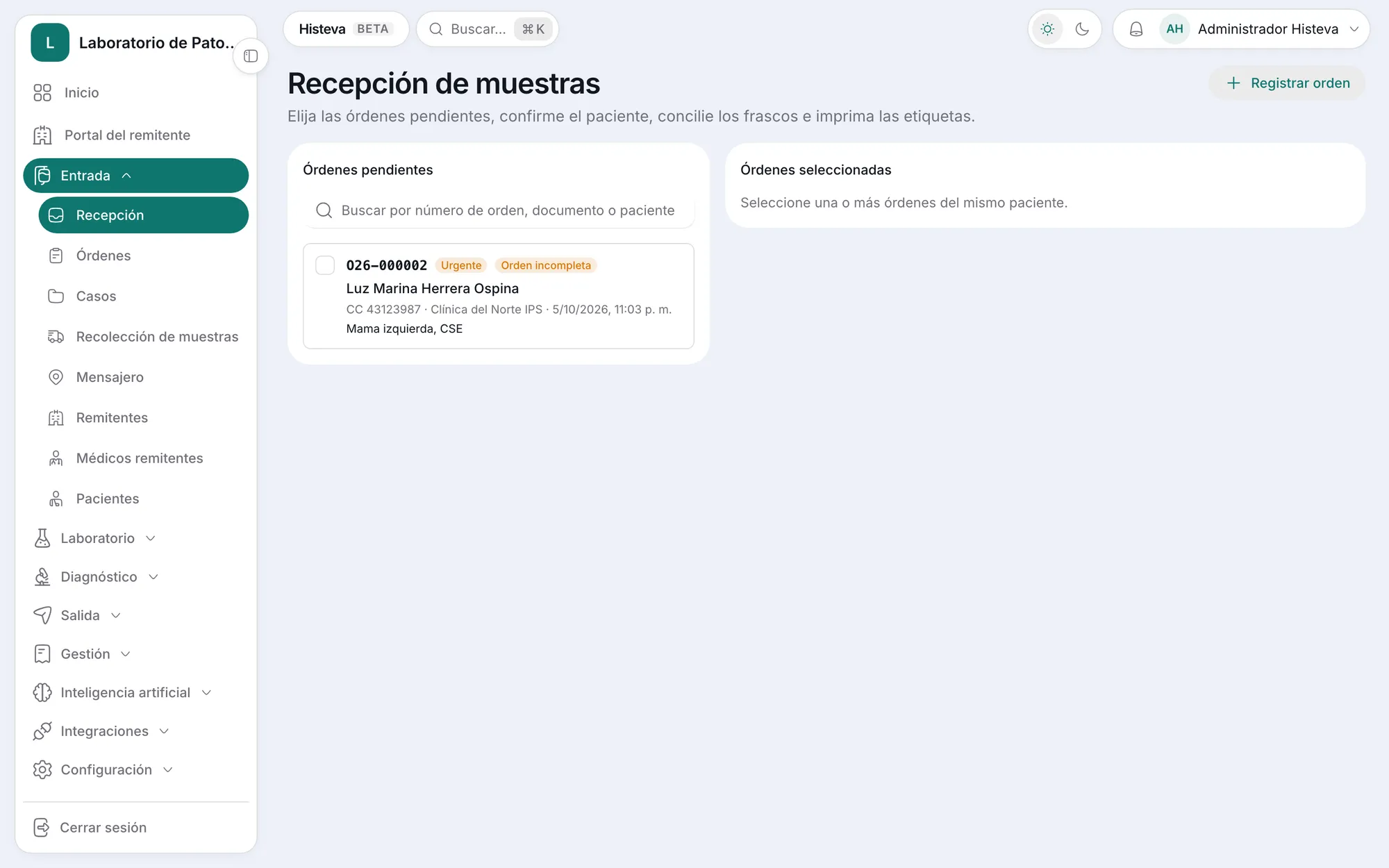
Intake. Orders via HL7 v2 (ORM and OML over MLLP), FHIR R4, referrer portal or manual entry. Accessioning targets under 2 minutes per case: it confirms two identifiers, reconciles the specimen containers against the order, records discrepancies and prints DataMatrix labels, with a target of under 3 seconds per label.
Lab. 12 grossing templates by specimen type, dictation, annotated photos and a cassette plan. Processing, embedding, sectioning, staining, coverslipping and dispatch stations that work by scanning, with wrong-sequence alerts and a real-time dashboard. A catalog of 56 stains and techniques and 7 panels, with controls, reagent lots and inventory deduction.
Cytology and intraoperative consultations. Bethesda 2014, the Paris System, Bethesda for thyroid and the International System for serous fluids. Rescreening of at least 10% of negatives and cytohistologic correlation. Intraoperative consultations with a 20-minute timer and verbal confirmation of the result.
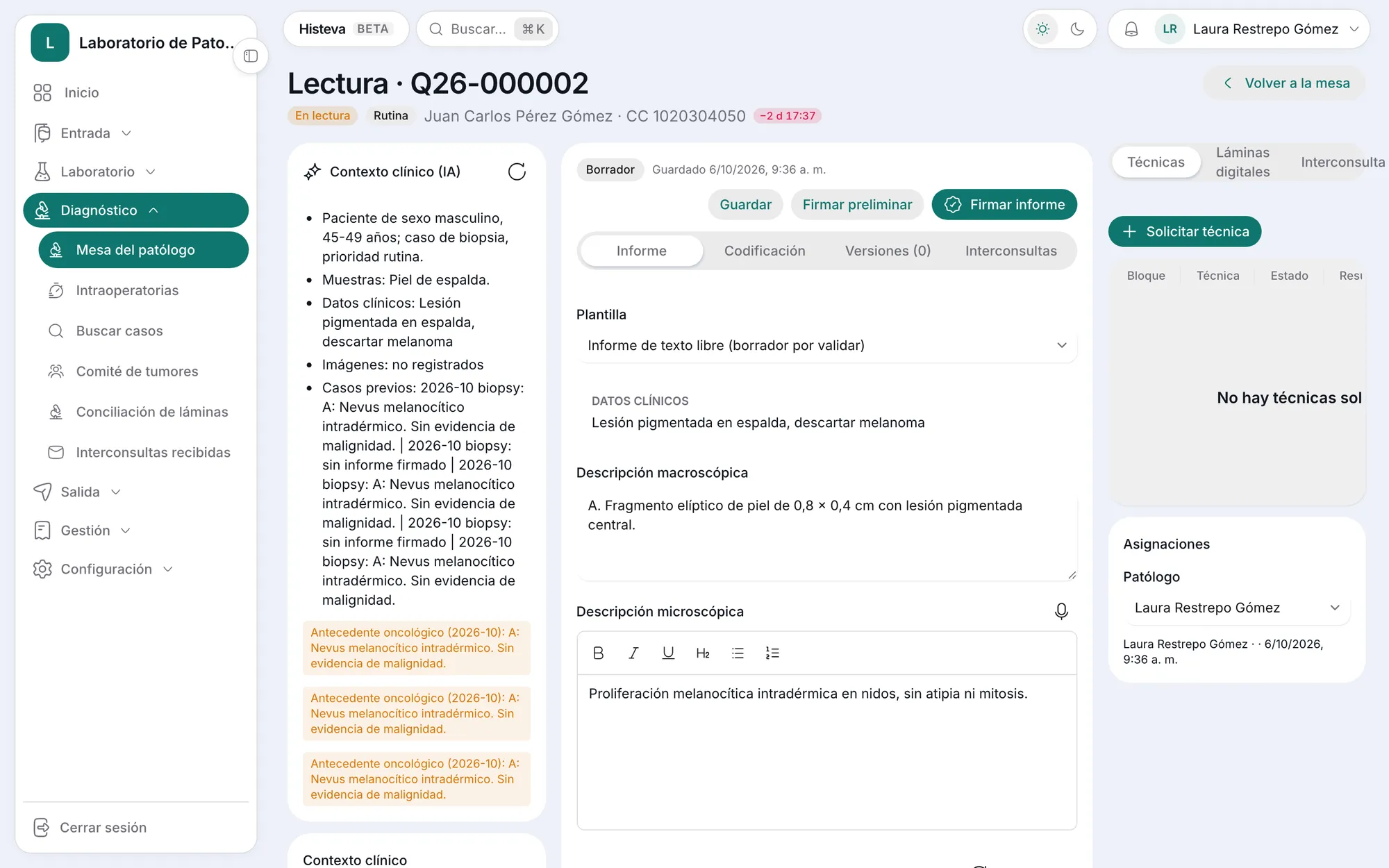
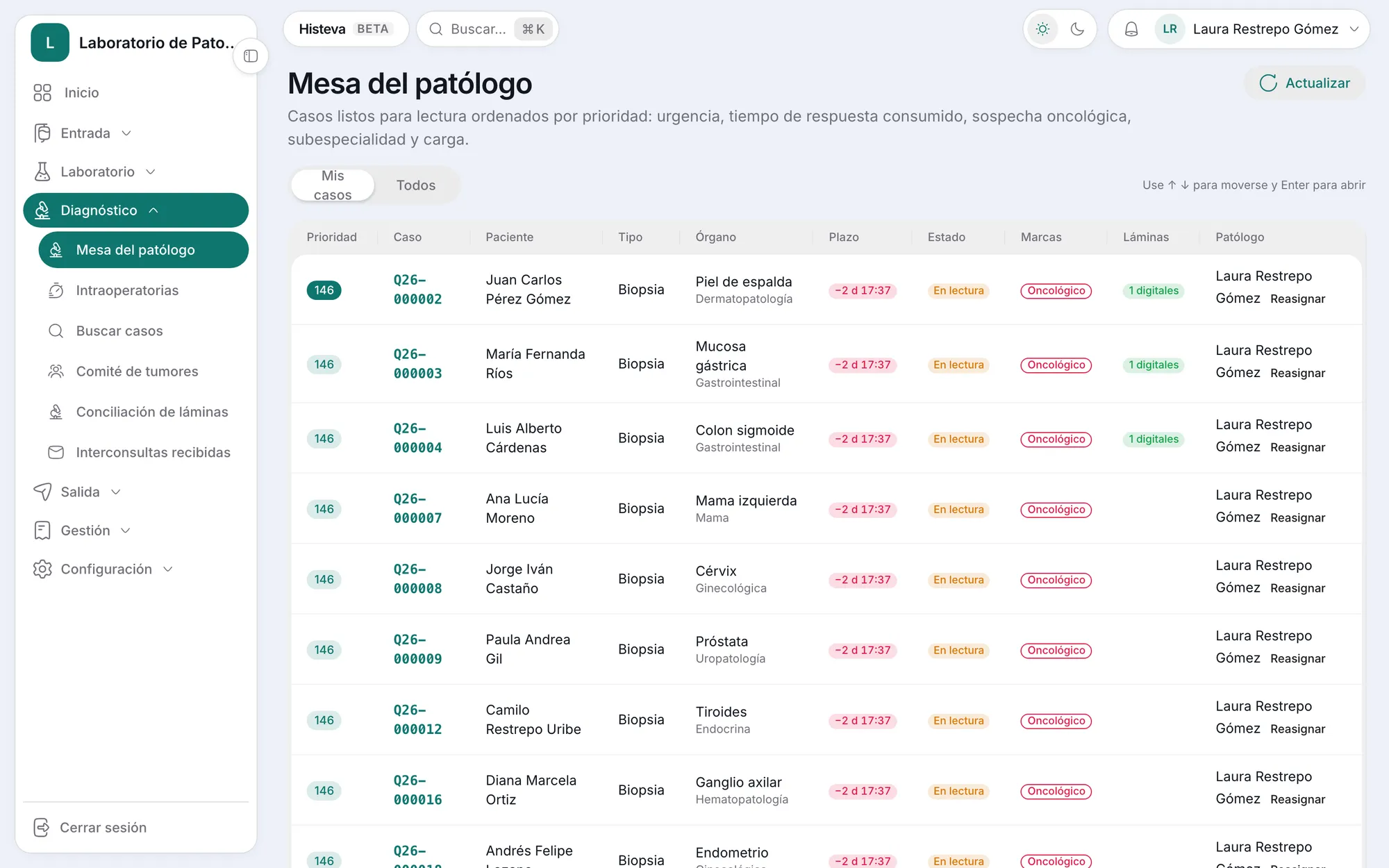
Reading and reporting. A pathologist worklist sorted by urgency, turnaround time used in business days, suspected malignancy, subspecialty and workload, with 12 subspecialties. 22 report templates, 9 of them ICCR oncology protocols. Two-factor sign-out, an immutable version with a SHA-256 hash and a PDF/A with a QR code that anyone can verify.
Delivery and reporting. Results via HL7 ORU with the PDF embedded, FHIR, email, portal and WhatsApp notification. Malignancies and critical findings are escalated until someone confirms they read them. Cancer reporting to the CAC, SIVIGILA events 155 and 115, PyP (promotion and prevention) reporting under Resolution 202 of 2021 and the Resumen Digital de Atención (digital care summary) in FHIR, prefilled from the report.
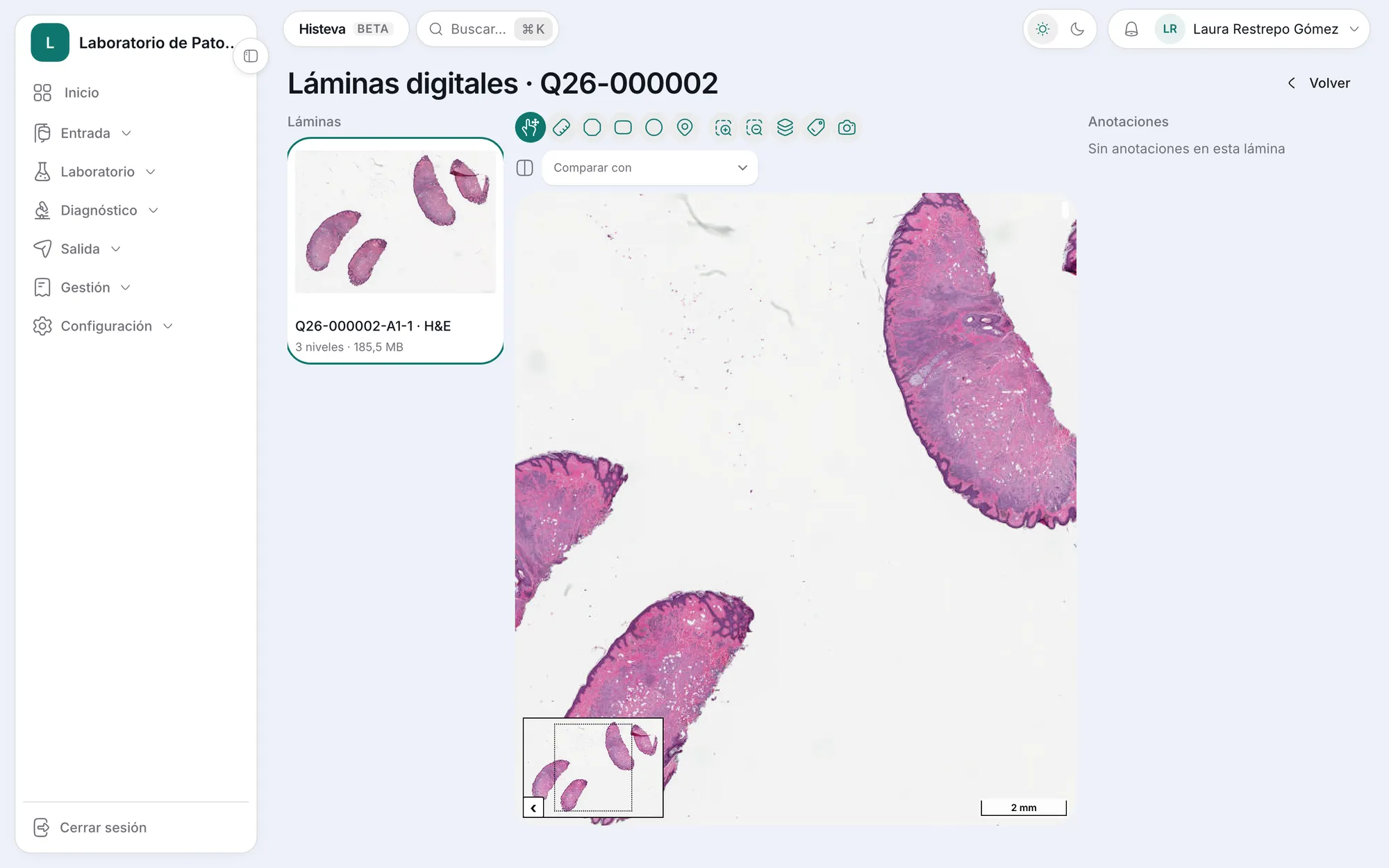
Digital slides. The scanner drops the file into a folder, the site's Edge converts it to DICOM WSI and the slide links itself to its case. See digital pathology.
Quality. Nonconformities, second reads (including blinded ones), ISO 15189-oriented indicators and an exportable evidence package.
Turnaround times by case type
| Case type | Default turnaround time | How it is counted |
|---|---|---|
| Small biopsy | 3 business days | Colombian calendar with Ley Emiliani holiday shifts |
| Surgical specimen | 5 business days | Colombian calendar with Ley Emiliani holiday shifts |
| Cytology | 5 business days | Colombian calendar with Ley Emiliani holiday shifts |
Turnaround times are configurable per lab. The goal guiding the product is for 90% of small biopsies to go out within 3 business days, which is why every case transition is recorded: time per stage comes straight from that record with no extra work.
Standalone or connected to your HIS
With any HIS. Histeva receives orders and returns results via HL7 v2 or FHIR R4. If a referring client has no interface, they create their orders in the portal and track the status of their cases there.
With Omneri HIS. If the institution already bills in Omneri, Histeva delivers the items ready to bill and does not issue its own invoice.
At every site. The Histeva Edge handles ZPL printers, scanners and stainers. If the internet goes down, the site keeps receiving specimens with reserved numbers and syncs when the connection comes back. Signing out the report does require a connection.
Security, AI and regulated development
Clinical roles sign in with two-factor authentication, every access to health data is audited, and each lab's data is isolated with its own encryption key. Data processing follows Law 1581 of 2012, Colombia's personal data protection law.
Histeva has 9 AI agents: order reading, grossing dictation, clinical context summary, synoptic draft, consistency check, code suggestion, cancer reporting, patient explanation and daily quality review. All of them start switched off and move from off to shadow mode to active only after an approved evaluation. They never receive the patient's name or ID number, they are audited, and they never sign or change the status of a case.
The software is developed under IEC 62304, with a preliminary Class B classification.
You can review the features, see how it works step by step or book a demo.